
December 10, 2025
Background:
The quality of both underground and surface waters throughout Cape Cod and the Islands has become significantly degraded primarily because of nutrient pollution from disposal of inadequately treated wastewater. The majority of these harmful nutrients enter residential wastewater in the form of urine (estimated at around 80% of the nitrogen and 50% of the phosphorus). By diverting and managing urine separately from wastewater we believe it may be possible to efficiently intercept and manage this key source of nutrient pollution before it enters the environment. Given the high costs of expanding conventional wastewater treatment practices, interest in UD eco-toilets appears to be growing.
MASSTC has been working with the Town of Falmouth and the MassDEP for the past 3+ years to explore this concept, identify regulatory approval pathways, and to develop an implementation project. Initially the project team was targeting the installation and monitoring of 50 to 75 residential systems with the goal to advance UD toward general use approval. More recently, MASSTC has received a grant through MassDEP 319 program that provides funding for the installation and monitoring of a more targeted project consisting of 25 systems installed within 4 specific embayment watershed areas in the Town of Falmouth (Waquoit Bay, Green Pond, Bournes Pond and Great Pond). With this funding in hand, MASSTC is working to complete this project as a first step toward validating performance and gaining approval for general usage of UD eco-toilet systems for watershed-scale pollution reduction.
Approach:
This implementation project aims to study the functionality and performance of both new and existing UD systems installed within the targeted watersheds described above. In order to complete this project we are needing approvals from the MassDEP, the Board of State Examiners of Plumbers and Gas Fitters, and local approving authorities. Once we have all necessary approvals we will begin to install, operate, and monitor UD eco-toilet systems so we can collect data on functionality and nutrient removal performance and determine if broader implementation could provide significant benefit to municipalities working to meet nutrient TMDLs in impaired watersheds. If we find promising results, we will be looking to move UD to general use approval as a generic system to allow broader implementation as a pollution reduction tool that would be available to municipal watershed planners throughout the Commonwealth.
MASSTC and our partners have compiled a list of more than 50 potential participating locations within the targeted watersheds and have begun the process of evaluating those locations for project compatibility. Once the onsite evaluations are complete, property owners will review results and decide if they want to participate. If a property owner decides to participate they will sign a participation agreement with MASSTC that outlines project eligibility, reimbursement terms, and responsibilities of both parties (MASSTC and project participants) related to operation, maintenance, and monitoring of the UD systems during and after the grant period.
Key components of the proposed project include:
1. Installation of code compliant UD toilet fixtures and associated plumbing and storage systems.
2. Operation, maintenance, and monitoring of installed systems.
3. Removal of urine from collection sites and storage and processing at MASSTC.
4. Approved processing and usage of urine derived fertilizer products per MassDEP and MDAR.
5. Disposal of any unused urine and/or residuals from fertilizer production at WWTP.
System Specifications:
UD system installations will consist of specialized UD eco-toilet fixtures and/or urinals that are connected to a dedicated plumbing system and storage tank. Urine collected in the UD eco-toilet or urinal fixtures flows by gravity into a storage tank where it is held until being pumped out by an approved hauler. All UD system components will be designed and installed pertaining to applicable plumbing regulations, including but not limited to pipe type and diameter, material and slope, venting, high water alarm, and pump out port accessible outside of the building.
Operation and Maintenance (O&M):
O&M procedures for UD and combined UD and composting eco-toilet system components are specified by product manufacturers. General system O&M typically entails visual inspection of all system components, testing of mechanical components (high water alarms, overflow pumps, and liquid traps), and discussion with system users to identify any issues or concerns. In the event that an issue is reported by the system owner or identified during an inspection, MASSTC or an approved service provider will work to promptly address the issue. If repair is not possible, then the failing system component will be replaced. A customized O&M guide will be developed and provided to each system owner prior to initiation of usage. Quarterly inspections will be provided by MASSTC throughout the 319 grant funded period. Ongoing O&M beyond the grant period will be paid for at the system owners’ expense and provided by MASSTC or an approved service provider that has been trained and approved by MASSTC.
Urine Management:
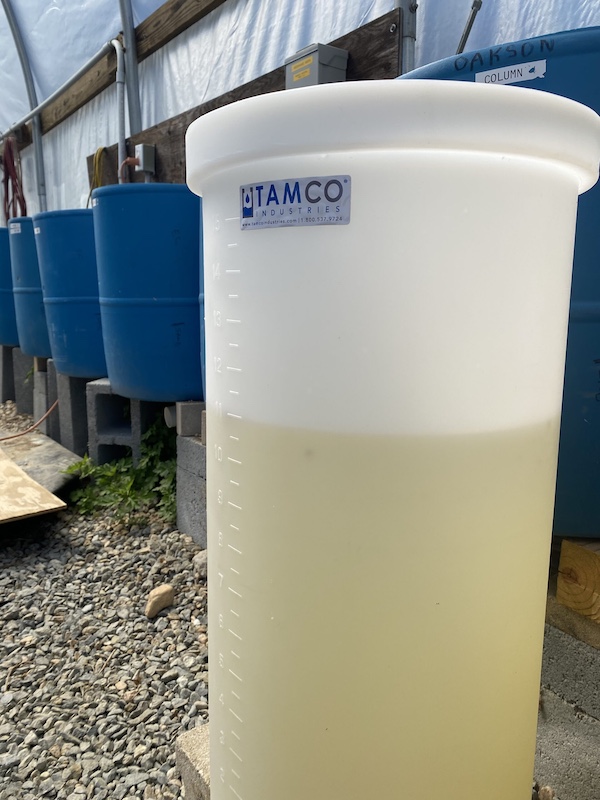
Urine that has been removed from a collection site will be transported to MASSTC where it will be measured, sampled, and stored. MASSTC will then process that material into fertilizer products for experimentation and application trials at the MASSTC site. Those products that have been approved by the Massachusetts Department of Agricultural Resources (MDAR) may be distributed to local end users (farmers, landscapers, golf courses, etc.) for application per MDAR plant nutrient rules. Any unused urine or residuals from fertilizer production will be disposed of at a wastewater treatment plant.
Monitoring:
MASSTC will visit sites quarterly during the 319 grant period to conduct system monitoring. Urine storage tank level will be observed to determine when pumping is needed. At the time of storage tank pump-outs, the total urine volume at each site will be measured and sampled for total nitrogen and total phosphorus (N&P) concentration, allowing calculation of the total nutrient load removed from each site. Remaining nutrient load flowing to the onsite septic system at each participating site will be tracked by measuring flow volume and concentration of N&P at the septic system distribution box. By documenting both the load removed and the load remaining we can back calculate the load if UD were not in use and produce a removal percentage. These data will inform any future nutrient removal credit that may be applied at the watershed scale (as nutrient load removed in urine) or at the site scale (as load reduction at the site). Overall system functionality will be tracked during site visits involving conversations with system users and inspections of all system components. As a first task in our Scope of Work for the 319 grant MASSTC is developing a Quality Assurance Project Plan (QAPP) to detail all monitoring activities. This QAPP will be formally approved by both MassDEP and U.S. EPA before any monitoring activities are completed.

Participant Selection Criteria:
Due to limited funding and high participant interest not all sites will be eligible for inclusion in the project. To make the selection process as fair as possible the project team will rely on certain selection criteria to determine which sites will participate. These criteria listed below aim to prioritize the most compatible sites for the project. If a project is not selected for inclusion in this current project we will maintain that site on our list for inclusion in a future project as we intend to seek additional funds for future installations, pending good results from this first project. Selection criteria may include, but are not necessarily limited to:
1. Willingness to sign participant agreement (based on estimated cost, willingness to pay beyond the subsidy amount if needed, and approval of proposed system configuration).
2. Occupancy/seasonality – with preference to year round regular residence.
3. Lower cost less complicated installations (assuring installation can be completed in reasonable time frame and within project subsidy/homeowner budget).
4. Willingness to replace all toilets with UD or composting to present a best case nutrient reduction scenario. Note that homes with a single toilet and unfinished basement may be ideal in terms of project simplicity and cost.